

How Much Does an ADU Cost in Minneapolis? (A Realistic Budget Guide)
If you are a Twin Cities homeowner over 35, you likely view your home as more than just a place to live - it is your largest financial asset. With the progressive zoning updates under the Minneapolis 2040 plan, transforming your backyard into a dual-income stream or an independent space for aging parents has become highly viable.
But once you begin researching backyard guest houses or accessory dwelling units (ADUs), you will immediately hit a confusing roadblock: the price tags are all over the map. Some online articles promise a complete backyard cottage for $60,000, while local contractors quote well over $350,000. What is the real cost to build an ADU in Minneapolis?
A realistic budget requires breaking down the local variables, uncovering hidden Minnesota cost drivers, and understanding how modern factory-built construction can protect you from traditional budget creep.
The Real Numbers: Minneapolis ADU Cost Breakdown
To build a detached ADU legally and safely, your total development investment is divided into three distinct buckets: Pre-Construction (permits and design), Site Preparation (foundation and utility hookups), and the structural Build itself.
For a standard, high-quality, fully finished detached ADU in the Twin Cities, here is what a realistic budget looks like:
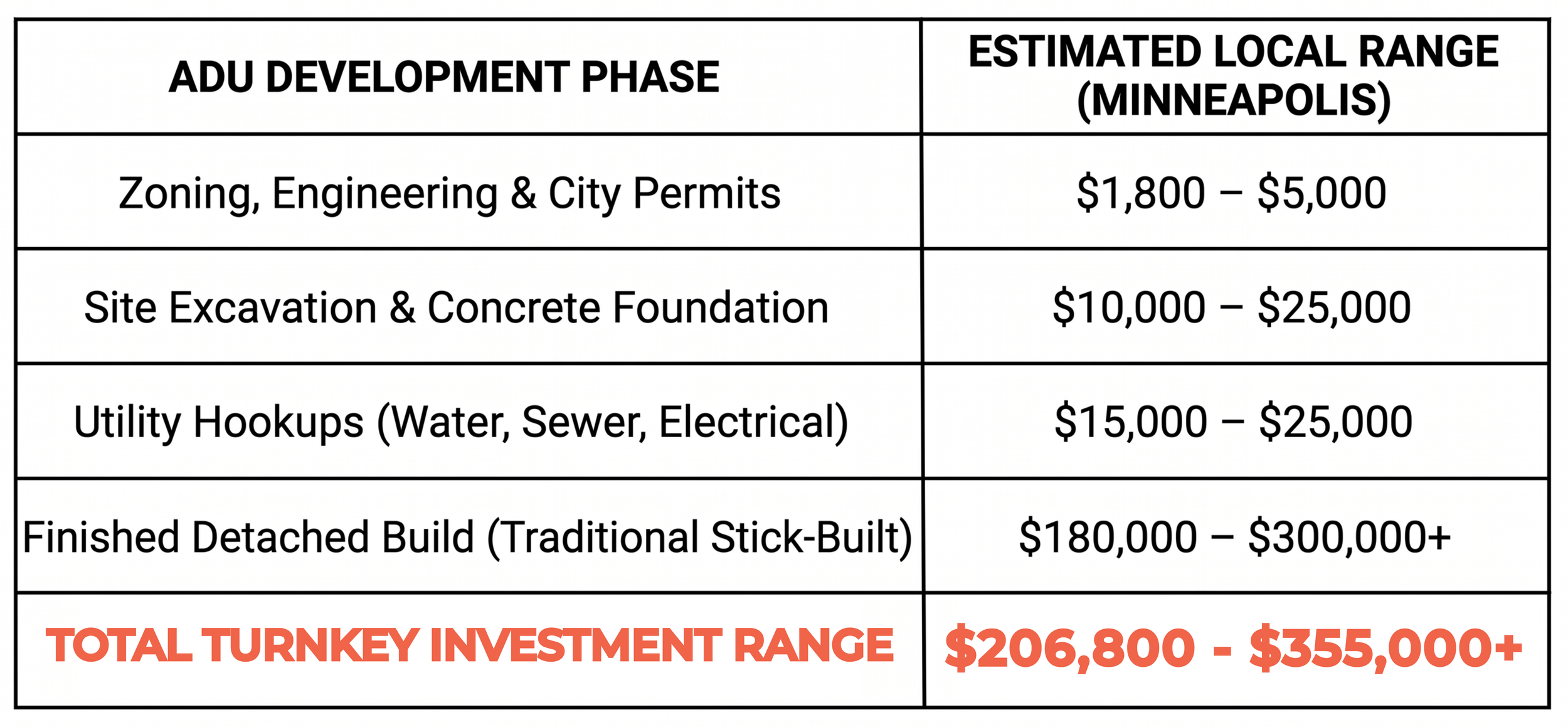
Note: While garage conversions or internal basement suites can cost less ($80,000 – $150,000), standalone detached backyard cottages require completely new infrastructure, which drives the baseline cost.
Hidden Cost Drivers Unique to Minnesota
Building a secondary home in Minneapolis isn't quite the same as building one in California or Texas. Our harsh environment and strict regulations present unique, non-negotiable cost drivers:
1. The 4-Foot Frost Line
Minnesota building codes dictate that any permanent detached structure must be anchored safely below the freeze-and-thaw cycle of our soil. This means your site prep must include digging deep, engineered frost-depth footings or pouring a robust, insulated frost-protected shallow foundation (FPSF). This critical step adds thousands to initial excavation bills compared to warmer climates.
2. The Strict Minnesota Energy Code
To stay comfortable at -20°F, Minneapolis requires residential structures to feature exceptionally high insulation values ($R-values$) and pass mandatory blower-door testing for structural airtightness. Achieving these net-zero performance thresholds on-site using traditional wood framing requires specialized, high-cost insulation techniques and precision vapor-barrier detailing, driving up both material and skilled labor costs.
3. The Unpredictable Construction Window
Our outdoor construction window is compressed, stretching roughly from late April to October. If a traditional "stick-builder" encounters early autumn blizzards or structural material delays, your project easily stretches into the winter. Winter construction means paying premium rates for ground-thawing equipment, temporary tent heat, and extended crew labor.
The "Change Order" Trap of Traditional Building
Ask anyone who has managed a traditional home remodel or addition past the age of 35, and they will tell you the same thing: the initial quote is rarely the final price. When building entirely outdoors in a backyard, traditional contractors frequently run into unexpected site issues. Wet weather warps raw lumber left sitting in the yard, sub-contractors fail to show up on schedule, and minor framing calculation errors lead to expensive "change orders."
Traditional builders often recommend keeping a 15% to 20% cash contingency reserve just to cover these unpredictable mistakes during the build phase.
The Modular Solution: How Hopewell 360 Controls the Cost
The reason homeowners are turning away from traditional construction isn't just about the final look, it’s about financial predictability.
By utilizing precision modular construction, Hopewell 360 flips the script on traditional building economics. Because 80% of our building process happens inside a climate-controlled factory facility, we eliminate the primary drivers of budget inflation:
Fixed Factory Pricing: Building indoors allows for exact, automated material calculations. We buy our premium materials upfront, shielding your budget from sudden market price fluctuations and eliminating line-item change orders.
No Environmental Damage: Our high-performance insulated panels are assembled in a dry, covered environment. There is zero risk of wood warping, moisture trapping, or mold growth, which guarantees a structurally tighter, higher-quality home.
Rapid On-Site Timelines: While your factory modules are being built indoors, site excavation happens simultaneously in your yard. When the module arrives, it is installed and completed in a fraction of the time, sparing your backyard, your landscaping, and your neighbors from months of ongoing construction chaos.
Is an ADU Worth the Investment?
While a premium detached ADU requires a significant initial capital layout, it is one of the single most effective ways to maximize your existing property value.
In competitive Minneapolis neighborhoods like Northeast, Uptown, or Linden Hills, a beautifully finished 1-bedroom backyard ADU can realistically command $1,600 to $2,000+ per month in rental income. That turns an underutilized patch of lawn into an immediate cash-flowing asset that builds long-term generational wealth.
Ready to find out exactly what it takes to add a smart, high-performance ADU to your property? Connect with our team to explore your options, or head over to ourHopewell 360 FAQs page to learn more about how our building process saves you time and money.
References & Local Resources
Minneapolis 2040 Comprehensive Plan: Framework for citywide residential land-use reforms, eliminating owner-occupancy requirements and parking mandates for ADUs.Minneapolis 2040 Housing Goals
City of Minneapolis Community Planning & Economic Development (CPED): Fee schedules for local building plan checks, state surcharges, and land-use permits based on structure valuations.City of Minneapolis Director's Fee Schedule
Minnesota State Legislature Chapter 1300: Structural definitions, permanent foundation mandates, and the distinction between factory-built modular structures (IRC regulated) and manufactured homes (HUD regulated).Minnesota Department of Labor and Industry (DLI)
Metropolitan Council Environmental Services (MCES): Sewer Availability Charge (SAC fee structures) for standard 1-unit residential infrastructure additions in the Twin Cities.Met Council SAC Program
Twin Cities Real Estate & Rental Index: Average monthly yields for 1-bedroom freestanding accessory residential structures in core Minneapolis residential neighborhoods.
